
The benefits of working remotely were never made clearer than during the worst of the pandemic. It seems the benefits of office-based working are clear now, too.
Statistics Canada doesn’t maintain official estimates of “office-based” employment. On the one hand, this makes it difficult to objectively assess how the pandemic impacted such white-collar jobs; on the other hand, it provides us dataphiles with an opportunity to problem-solve.
Using data on occupations (that is, classifying people by what they do as part of their jobs— as opposed to what their employer produces, which defines industry classifications of employment), we’ve grouped employment into office and non-office roles and examined how these two broad groups of jobs have been faring over the past couple of years.
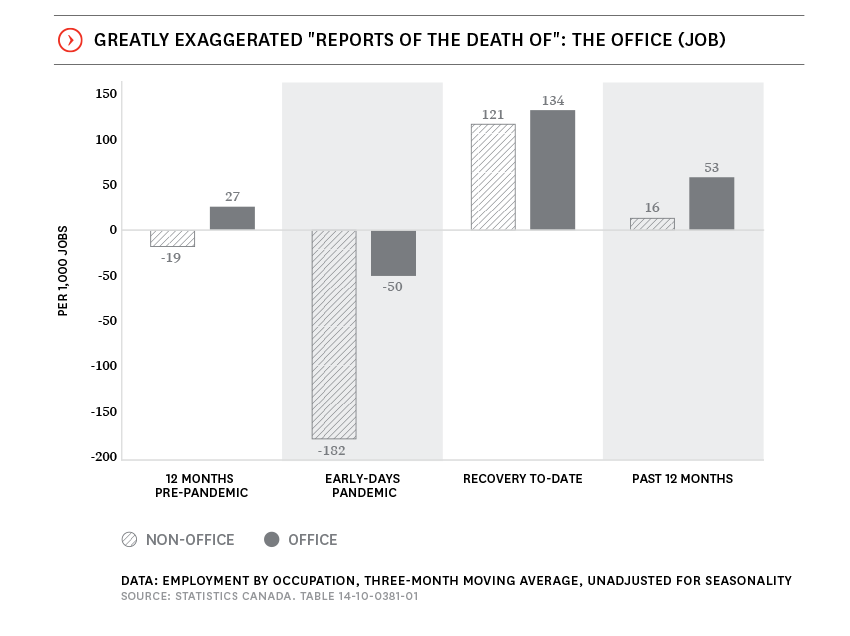
Interestingly—considering the popular narrative around office-based employment evolving into something of a relic—the data for Metro Vancouver show that office-based employment has not only been resilient over the past two years, but it has grown by more than non-office roles.
Specifically, this region lost only 50,000 office-based jobs in the first few months of the pandemic, versus 182,000 jobs lost in the rest of the economy. And since then, office-based employment has grown by 134,000 jobs versus 121,000 in non-office environments. In the last year, 53,000 jobs have been added in office-based settings compared to only 16,000 elsewhere.
Twice a year, rennie intelligence produces the rennie landscape, which tracks various demographic and economic indicators that directly and indirectly influence our housing market here in Metro Vancouver. Our goal is to provide our community with a basis for evaluating the trajectory of the factors that collectively define the context for the real estate market.