
Statistics Canada recently published national and provincial population estimates for Q4 2025, providing the clearest window yet into the impacts of the federal government’s recent change in immigration policy. Here are three of the biggest takeaways from the perspective of British Columbia.
1. Canada’s Population Has Declined for the First Time Ever
You read that right—in 2025, Canada registered its first annual population decline since Confederation in 1867, which spans a period of 159 years. As illustrated in figure 1, the country’s population decreased by 102,436 residents last year, a stark contrast to the previous three years which saw cumulative growth in excess of three million people. Not even two world wars and two global pandemics managed to disrupt Canada’s continuous run of population growth.
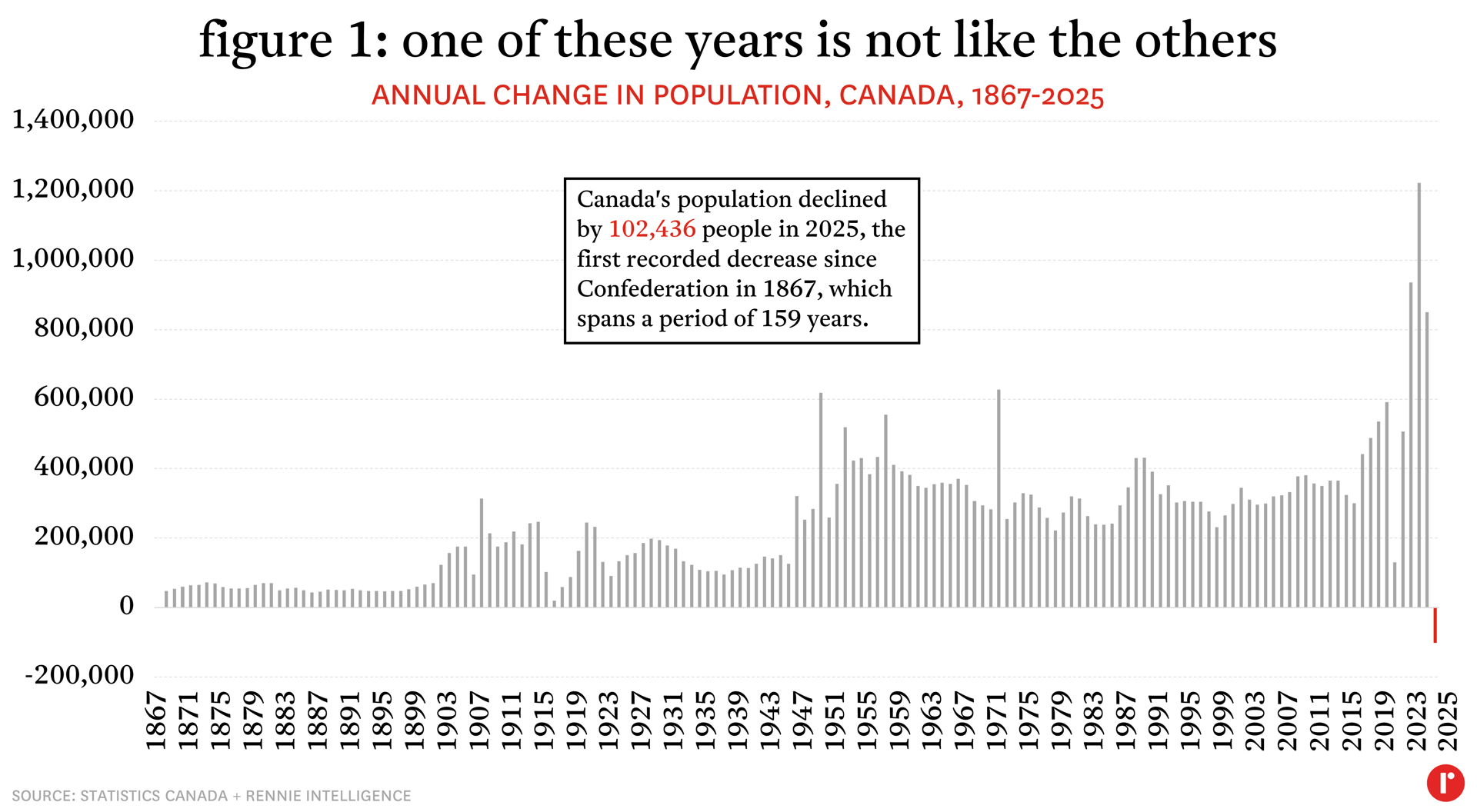
This decline had been anticipated ever since the federal government announced a profound pivot to immigration policy in October 2024. At the time, it declared its intention to reduce the number of non-permanent residents (or NPRs, which includes international students, temporary foreign workers, and asylum seekers) living in Canada to 5% of the national population by the end of 2026. That target was later postponed to the end of 2027. Last year, a net outflow of 461,688 NPRs was entirely responsible for the decline in population, which was only partially offset by net permanent immigration of 328,046 and a net natural increase (i.e., births minus deaths) of 31,206.
Since peaking at 3.15 million, or 7.6% of the population, in Q3 2024, the number of NPRs living in Canada has declined by almost half a million. Even then, at the end of 2025 they still accounted for approximately 6.5% of Canada’s population, highlighting how much further the government has to go in order to achieve its 5% target. rennie estimates that getting there would require an additional 600,000 NPRs to leave the country on a net basis over the next two years, which is expected to lead to population decline again in 2026 and 2027.
2. Nearly All of the Population Loss Has Been Concentrated in Two Provinces
Canada’s population decline was not spread proportionally across the country, with nearly all of the loss concentrated in the two provinces—Ontario and BC—with the largest shares of NPRs. More specifically, and as shown in figure 2, Ontario lost more than 119,000 residents in 2025, equal to 0.7% of its population, driven by a net outflow of 261,269 NPRs. In BC, a 41,461 (0.7%) decrease was attributable to a net outflow of 80,915 NPRs. Quebec also experienced a modest decline, while all other regions of the country, with the exception of Alberta, saw marginal growth. A relatively large gain of 59,970 (1.2%) in Alberta was supported by continued robust interprovincial migration to the province, as well as a large natural increase (Alberta accounted for 60% of Canada’s total natural increase in 2025).
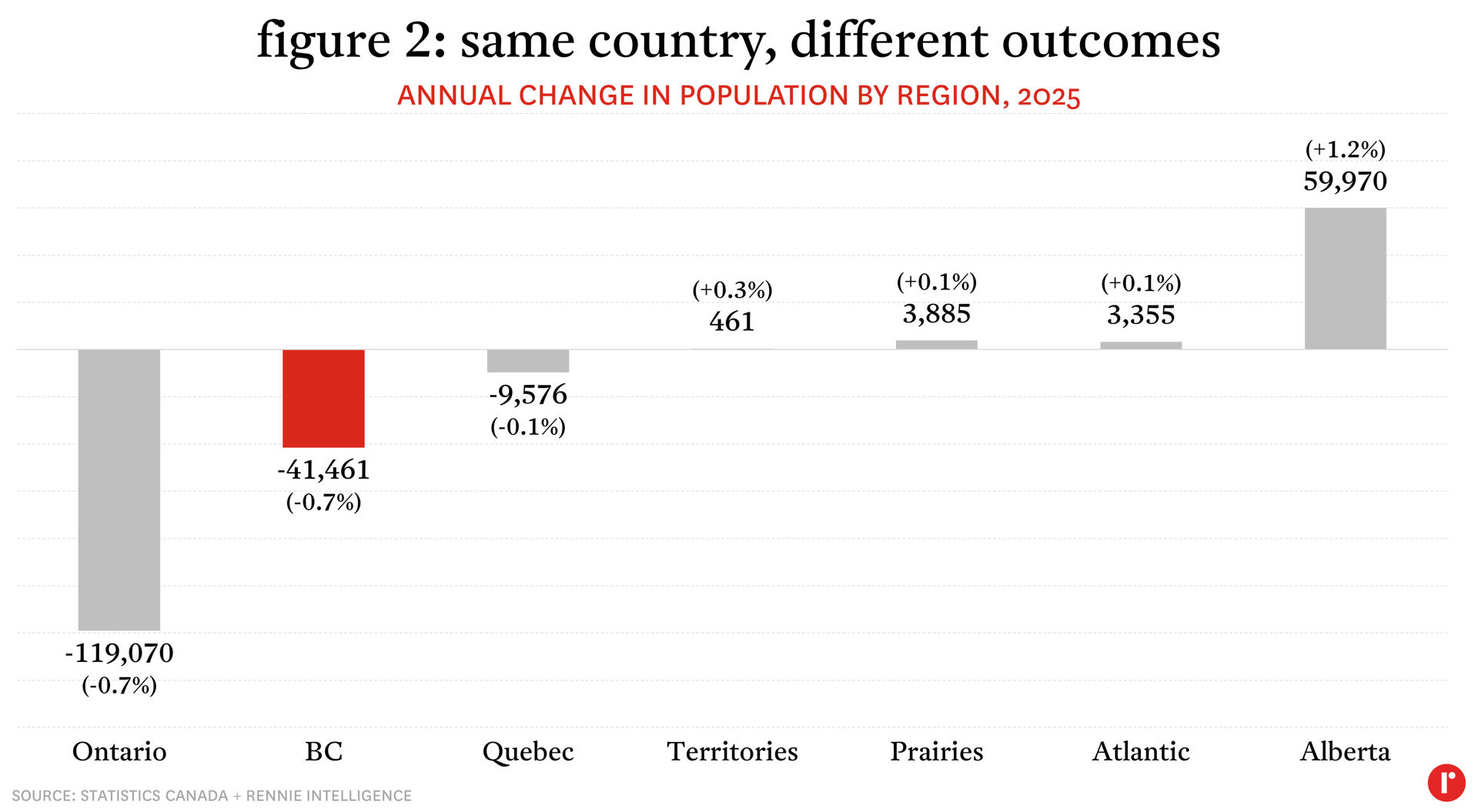
Focusing on BC, this was just the second time it has registered annual population decline since it joined Confederation in 1871—the first time was back in 1874 when it lost 2,000 residents. At the end of last year 7.9% of the province’s population was still NPRs, the highest share in the country. Continued NPR outflows are anticipated to weigh heavily on the population of BC.
3. Interprovincial Migration to Bc Has Quietly Turned Positive
Hidden by the magnitude of other news in the data release, BC has quietly strung together three consecutive quarters of positive interprovincial migration after seeing losses in eight of the prior 11. All told, the province saw a net gain of 3,175 residents from other provinces in 2025, a notable contrast to a net loss of 2,137 in 2024 and a much smaller gain of 718 in 2023.
Figure 3 shows that, although interprovincial migration has indeed turned positive, the gains have been marginal when compared to historical levels of growth. For 37 consecutive quarters from Q2 2013 to Q2 2022, BC added more people from other provinces than it lost. As a result, annual net interprovincial migration to BC averaged 16,875 from 2013 to 2022, about five times more than the realized gain in 2025. Thus, there is still a long way to go to restore what has historically been a foundational component of population growth in BC.
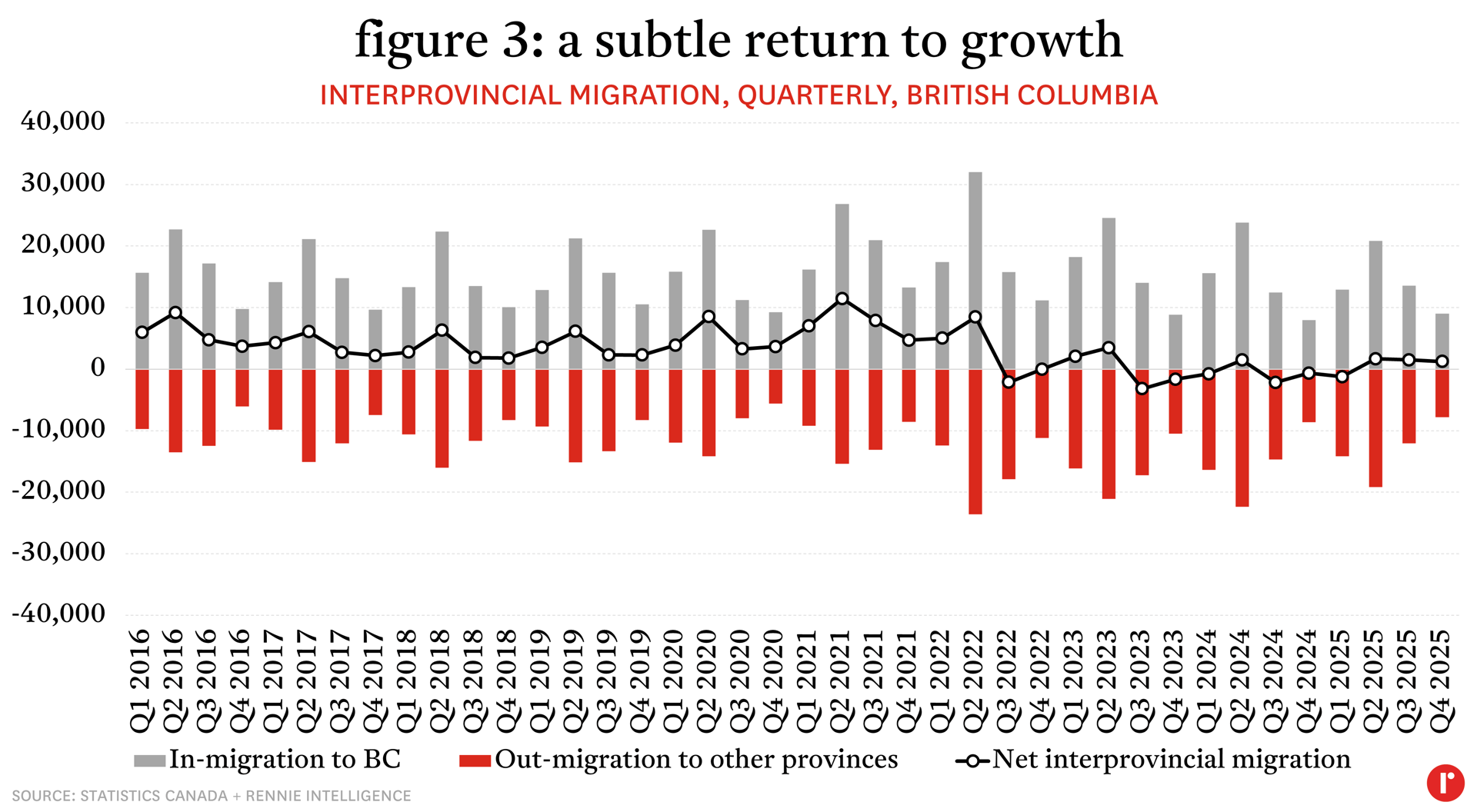
Reduced outmigration to neighbouring Alberta was among the primary reasons that interprovincial migration turned positive again in 2025. Though the province continued to lose more people to Alberta than it gained (by 2,956), this was down considerably from net losses of 8,962 in 2024 and 8,931 in 2023. Alberta has attracted significant volumes of people from all provinces in recent years, including BC, due to a relatively stronger economy and labour market, as well as relatively lower housing costs.
One reason that might explain reduced outmigration from BC to Alberta last year is falling rents, which is in part a function of reduced rental demand with fewer NPRs in the province. For example, Statistics Canada estimates that the average asking rent for a 1-bedroom apartment in Metro Vancouver declined 5% last year, to $2,320, and has declined more than 12% from its peak in Q3 2023.
Outside of Alberta, BC saw positive interprovincial migration with all other provinces in 2025, taking in a net 6,131 residents. The largest net gain came from Ontario (3,537), followed by Manitoba (1,116), Quebec (808), and Saskatchewan (534).