
While Canada has been experiencing a population boom unlike anything ever seen before—due mainly to a dramatic increase in the number of non-permanent residents entering the country—population growth at the provincial level is also impacted, to a degree, by people moving between provinces. Since the provincial government of our nearest neighbour embarked on its “Alberta is calling” ad campaign in an attempt to lure skilled workers to their province, much has been made about the recent outflow of British Columbians headed to Alberta. Even still, communities throughout BC, and the province as a whole (like Canada) have been experiencing record-high population growth.
So with that in mind, we thought it worthwhile to examine recent migration between BC and Alberta and how it compares to historical levels and patterns. But first, it’s worth looking at how BC fares in terms of net interprovincial migration with the rest of Canada (people moving to BC minus those moving from BC) for context.
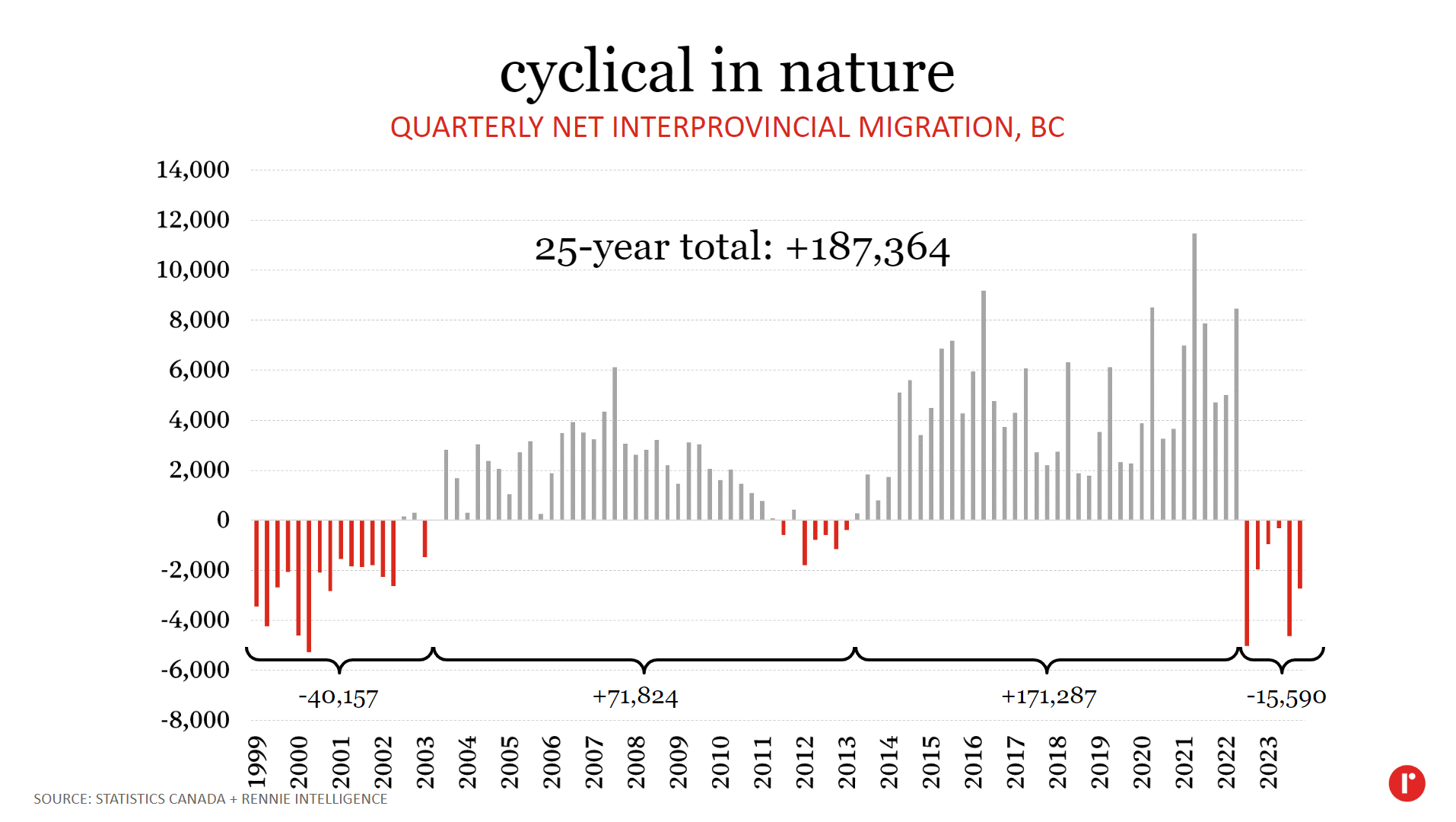
And while BC has seen its fair share of ups and downs in this respect, over the past 25 years the left coast has experienced a net gain 187,000 additional people with the rest of the country—that’s a number greater than the entire population of the City of Coquitlam. More recently, however, BC has seen a loss of interprovincial migrants: within the past 18 months (the most recent data available is from Q4 2023) more than 15,000 people on a net basis have left the province.
The majority of total interprovincial migration flows that both BC and Alberta experience consists of people moving between, well, BC and Alberta. And over the past 25 years, the pattern of interprovincial migration between these two provinces has, like BC’s pattern overall, been quite cyclical. In the late-1990s and early-2000s when BC’s economy wasn’t faring particularly well and Alberta’s was stronger, BC experienced net outflows of residents. And from 2015 (when oil prices crashed) to 2022 when Alberta’s economy wasn’t faring well and BC was doing comparatively better, it saw net gains in people moving here.
Overall, BC has attracted a little more more than 11,000 people from Alberta (on a net basis) over the past 25 years. And through most of that period the relative difference in the performance of the provincial economies and their labour markets was highly correlated with the movement of people. When BC has a higher unemployment rate than Alberta, as it did from 1999 to 2005, more people move from BC to Alberta. And when Alberta has a higher unemployment rate than BC, as it did from 2015 to 2022, more people move from Alberta to BC.
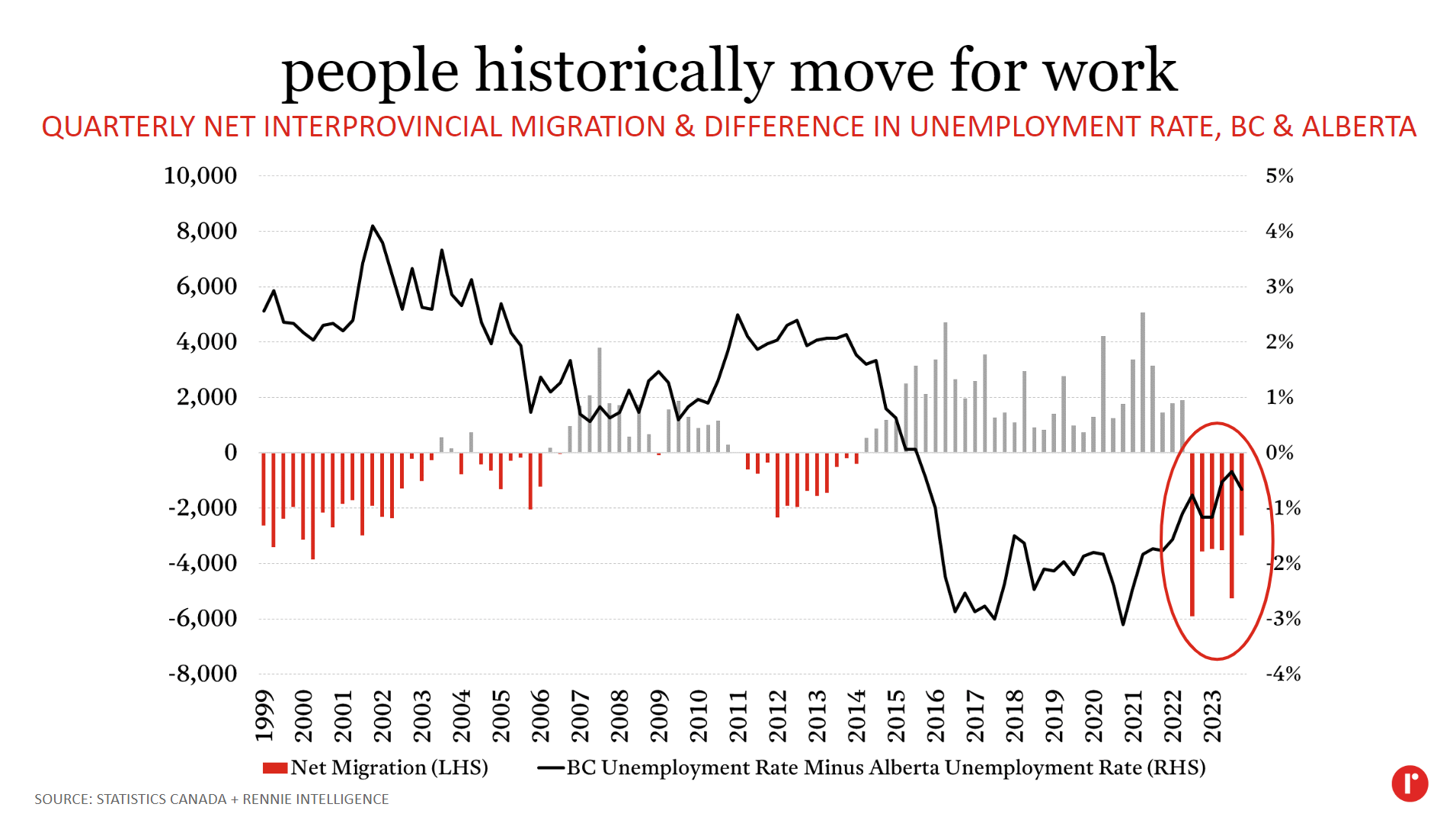
Since the second half of 2022, however, the relative difference in labour markets between BC and Alberta has not explained the movement of people between the respective provinces. From Q3 2022 through to the end of 2023, BC maintained a slightly lower unemployment rate but lost people, on a net basis, to Alberta. What’s more, BC lost a lot of people to Alberta over a short period of time: almost 25,000 people in 18 months. For comparison, BC gained almost 17,000 people, net, from Alberta in the preceding 18 month period.
It probably won’t come as a big surprise that one of the major differences between the two provinces of late has been the relative affordability of housing. While BC has always had higher housing costs than Alberta, the gap between the two provinces has grown substantially since 2015, reaching a peak in early 2022. That was when the tide of interprovincial migration flipped from a net inflow to BC to a net outflow, as the composite benchmark price for a home in BC was more than double that of Alberta.
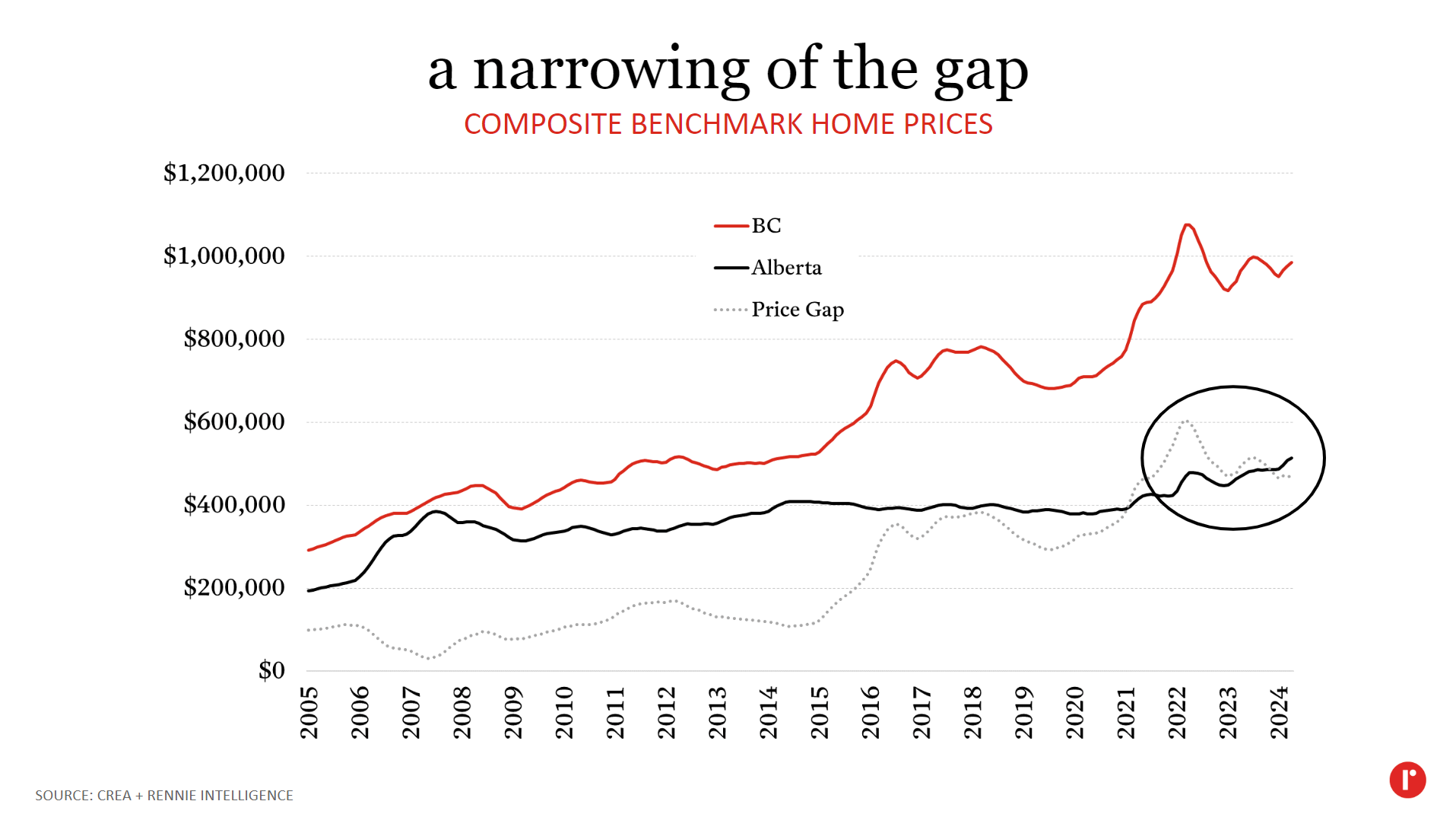
That gap has narrowed further in the first few months of 2024, as home price appreciation in Alberta has outpaced that of BC. And it’s a similar story in the rental market where rents (while still lower in Alberta) have been growing much more quickly in Alberta than in BC in 2024. While rental rate data is notoriously difficult to track, if we use the latest rent component of the Consumer Price Index from April, rents in Alberta were up 16% year-over-year compared with an increase of 7% in BC.
The respective labour markets of the two provinces have also evolved to-date in 2024. The theme nationally has been that population growth has been outpacing job growth, and that trend has been magnified in Alberta, leading to increases in the province’s unemployment rate—to 7.0% in April. BC meanwhile, has seen its unemployment rate decline more recently, to 5.0% which is the lowest in the country.
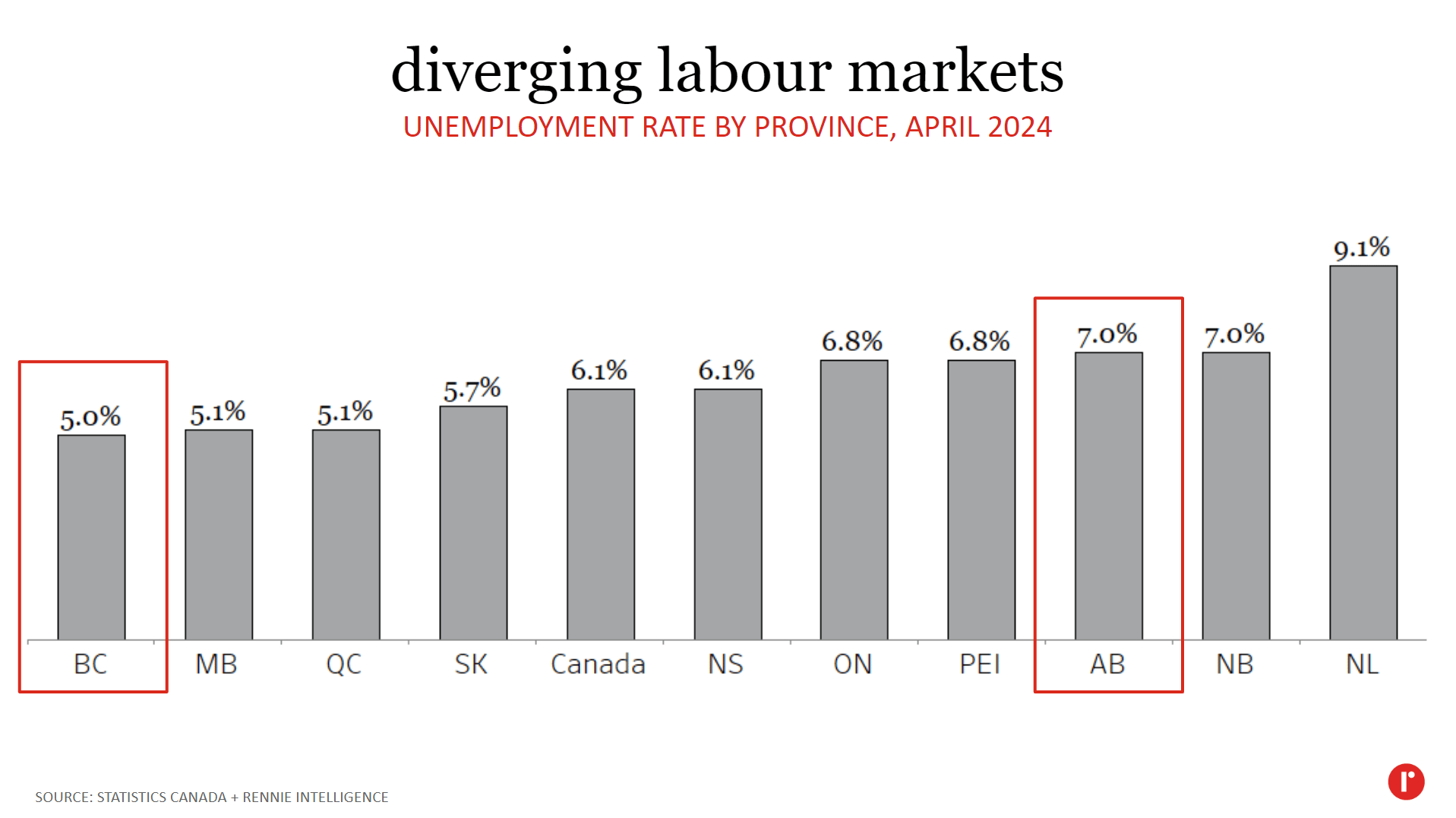
It remains to be seen whether the latest trends in the labour markets of Canada’s two westernmost provinces will continue, but if they do, history shows that when there is a gap of this size in the unemployment rates, that has served as a draw for people back to BC. And while overall housing prices are still much higher in BC than in Alberta, as values grow faster in Alberta and the gap narrows, there will likely be less incentive to move out of BC, at least at the margin. All of this suggests that as we progress through 2024, we may yet see the net outflow of people from BC to Alberta slow and perhaps even reverse in the months ahead if the trajectory of prices, rents, and jobs continue.