
Earlier this week, the Fed voted to keep interest rates unchanged, citing “a lack of further progress toward the Committee’s two percent inflation objective”. This came as no surprise as economic data to start 2024 had not provided them with the necessary confidence to begin cutting rates. Discussions to start the year centered on a handful of projected rate cuts before shifting to three cuts by year’s end. rennie intelligence questioned that forecast in March as a quarter of the year had passed, leaving limited time for consecutive data releases to build the confidence the Fed had so often cited. Since then, stubborn inflation and hotter-than-expected job numbers have continued to plague those hoping for a single rate cut in 2024—until today.
The latest jobs report from the Bureau of Labor Statistics (BLS) showed a significant deceleration in nonfarm payrolls, with additions totaling 175,000 in April (below the estimates of 240,000). While one month does not make a trend—indeed, we caution against putting too much emphasis on any one month-to-month job change, as the data can be shifty—this total marks the lowest number of additions since October of last year and 44% below the revised total of 315,000 from March. Today’s release shows a total that is more in line with pre-pandemic average monthly additions of 183,000 realized between 2010 and 2019.
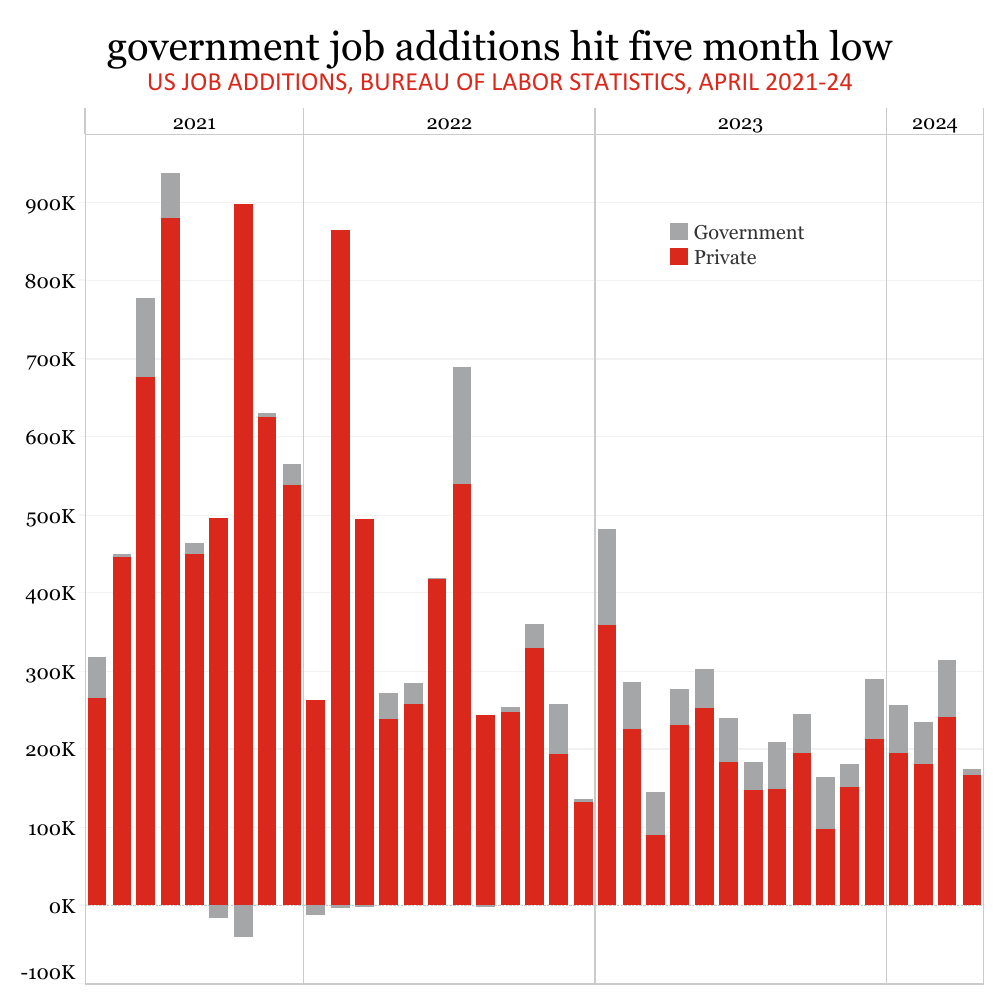
Adding 167,000, total private jobs drove the majority of the expansion in April while government positions accounted for 8,000 additions (or 5% of the total). This sum was the lowest number of government additions since December 2022 and a departure from the norm over the past year where government roles accounted for nearly 1 in 4 new jobs. On a more granular level, private education and health services led all sectors in April, adding 95,000 jobs, with retail trade (at 20,100 additions) and transportation and warehousing (at 21,800) having been the only other sectors to surpass the 20,000-threshold. Leisure and hospitality, which was responsible for 53,000 additions in March, fell to 5,000 in April, while construction fell from 40,000 to 9,000.
The unemployment rate ticked higher, to 3.9%, above the estimate of 3.8% but remaining below 4% for the 27th consecutive month. The last time a sub-4% unemployment streak of this magnitude occurred was back in the late 1960s, with April 2024 tying the second longest streak on record dating back to 1948. Perhaps more striking for the Fed, average hourly earnings increased 0.2% between March and April (below the 0.3% realized between February and March) and 3.9% during the past year (the lowest such increase since May 2021).
Wall Street took note of the news this morning as the Nasdaq and Dow futures rose 1.5% and 1.3%, respectively, and the S&P increased 1.1%. Just as this data release caused US stocks to spike, it also brought the potential for relief from 23-year high rates—which seemed to be getting further and further out of reach—back into view. This is the type of data release Chairman Powell was referencing as the Fed looks to build confidence before making a cut. With this said, the question now is if this was an anomaly or marked the beginning of consecutive releases reflecting an economic slowdown—the latter of which is necessary for any relaxation in borrowing costs to be realized in 2024.