
If you have two people in a room where one is 20 years old and the other is 80, and the average age in the room is therefore 40 years old—even though no one person in the room is actually 40—well, that’s one of many ways averages can be deceiving. And with Statistics Canada’s latest release of its Survey of Earnings, Payroll, and Hours (SEPH) for February, we have an opportunity to observe recent labour market trends as they relate to, among other elements, average earnings. How deceiving could they be?
At first glance, average weekly earnings from the survey appeared to be unusually robust. They were not only up 0.5% in February from the previous month, but 4.5% year-over-year as well. That this acceleration in wage growth occurred alongside declining payroll employment and employment per the Labour Force Survey is notable, if not surprising. Additionally, with Canada observing record-setting population growth of late, the availability of labour has grown by leaps and bounds. This has reduced job vacancies to near pre-pandemic levels, and has in turn alleviated some of the competition for workers that was previously exerting upward pressure on wages.
So then why the big jump in average weekly earnings in February? This is where averages can be deceiving, and some noteworthy trends start to emerge when we break things out by sector and look at the change in payroll employment alongside these earnings. Overall in February there were 14,336 payroll jobs lost (excluding unclassified sectors) and many of those job losses were concentrated in just a few sectors. Those sectors also account for some of the lowest average weekly earnings. Together, Accommodation & Food Services and Trade, for example, lost a combined 20,591 jobs in February and are two of the three lowest sectors in terms of wages.
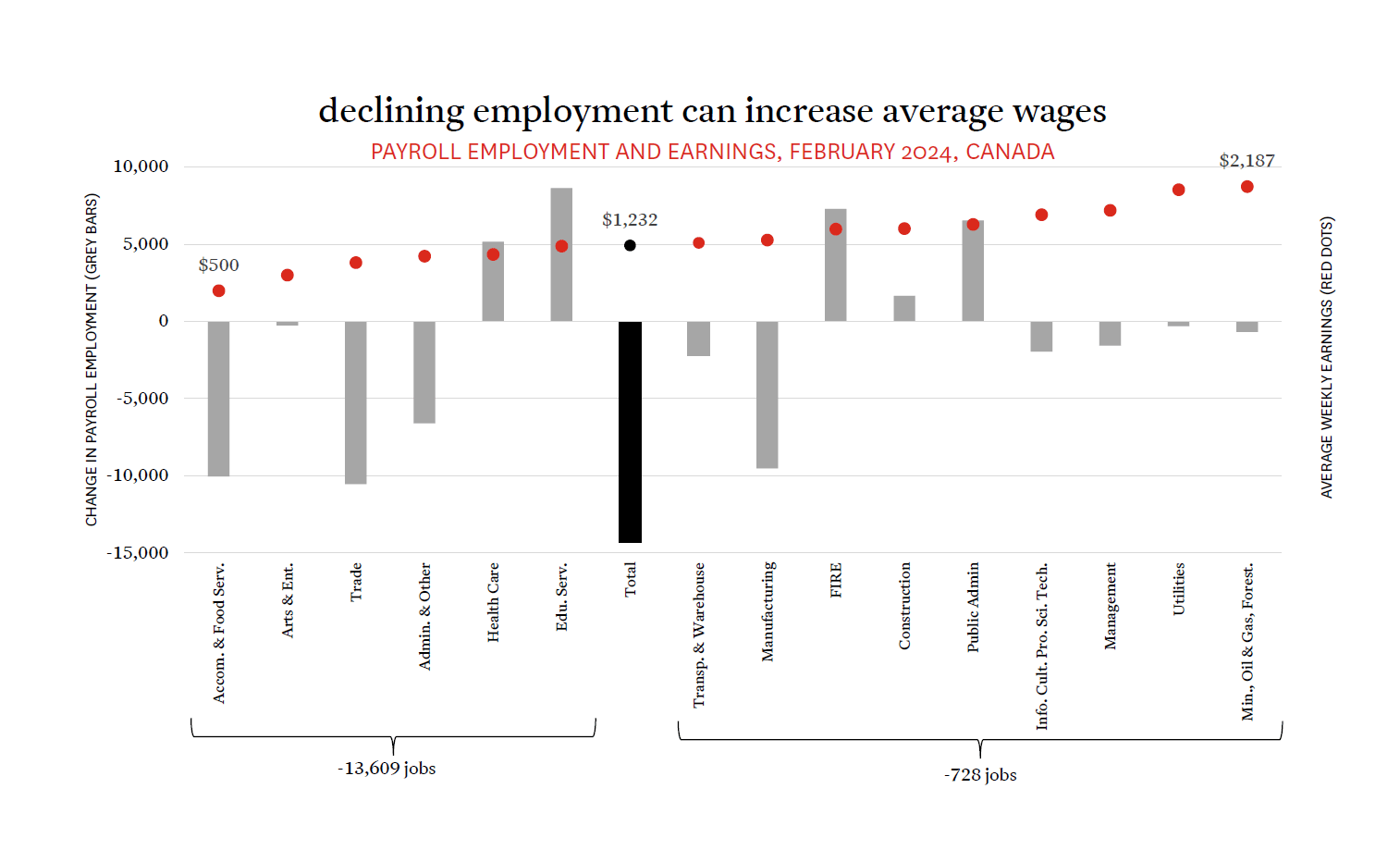
Overall, sectors with weekly earnings below the overall average of $1,232 accounted for 95% of the job losses in February, whereas those sectors with above-average earnings accounted for only 5% of the job attrition. This divide in the composition of employment changes has thusly played a role in average earnings rising: the relatively high proportion of job losses being realized in lower-paying sectors has meant that higher-paying jobs now account for more of total employment—thereby increasing overall average wages, all else being equal.
High wage growth has been a concern for the Bank of Canada in its fight to tame inflation and a 4.5% year-over-year increase is, quite frankly, not something they want to see when they’re contemplating rate cuts. The good news for the Bank (though perhaps not so much for employees) is that the average was, in fact, deceiving and the increase is being driven, at least in part, by job losses in lower-wage sectors and not in the growth of individuals' earnings.