Only The Few Buy Young
Would-be first-time buyers are generally the most sensitive to high prices and high interest rates—no surprise, then, that the housing market participation of this segment of the population has dwindled in recent years.
Home prices peaked across BC in the spring of 2022, shortly after the Bank of Canada embarked on its once-in-a-generation campaign to stamp out generationally high inflation. Since then, there was some recovery in 2023, before softening some more in the latter half of last year. And while prices today remain below their peak levels, across all home types, in markets throughout the province, relative affordability is worse now than it was then. That’s because the drop in prices was not enough to offset the increase in costs from higher interest rates. And that means buyers, on average, can afford less home today than they could in early 2022.
First-time buyers are impacted more by these changes in rates and prices than other buyers. And it makes sense, whether someone is a move-up buyer or downsizer, they have the equity in their current home to lean on when making their next purchase.
We can see that sensitivity manifests in the first-time buyer data, where pre-pandemic the provincial average share of purchases by first-time buyers was 12%. BC’s three largest rennie.com markets all had slightly lower shares, Metro Vancouver was 9%, Capital Region was 10%, while Kelowna’s first-time buyer share was 11%. This also tracks, as these markets are generally more expensive than the rest of the province, particularly Metro Vancouver.
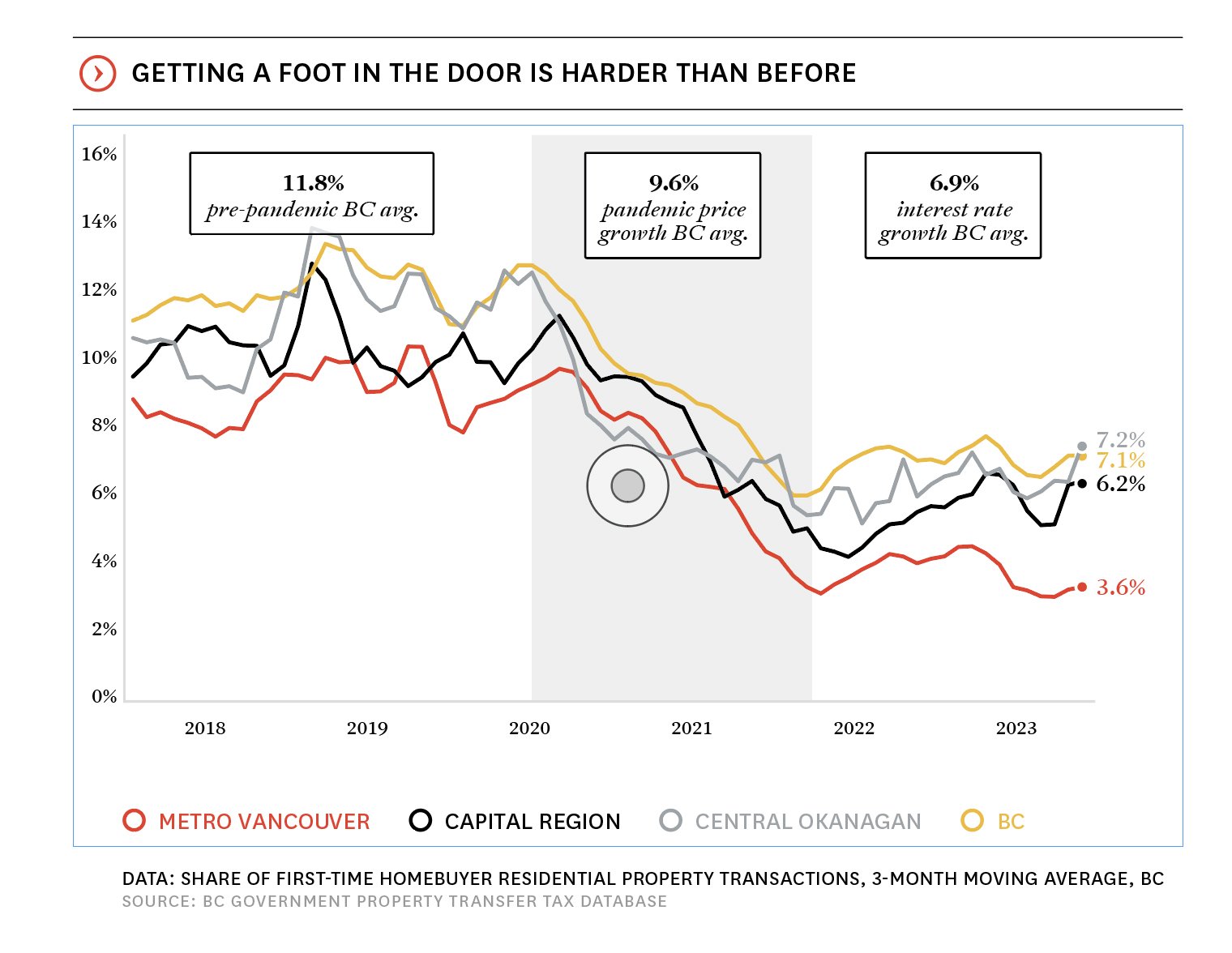
As rates fell and prices rose in 2020 and 2021, those shares declined (though the actual number of first-time buyers grew) to around 8% for all three metro areas. Most recently, as interest rates shot up and prices only softened, the share of first-time buyers fell more, even compared to much lower sales counts. Since March 2022 the share of first-time buyers in the Central Okanagan was 6%, while in the Capital Region 5%, and in Metro Vancouver it has fallen all the way to 4%.
We know that changes in prices or interest rates don’t affect everyone equally, and in the case of recent changes, particularly today’s high rates, it’s first-time buyers that have been largely pushed out of the market, though as we observed before renewers aren’t having a great time either.
Twice a year, rennie intelligence produces the rennie landscape, which tracks a variety of demographic and economic indicators that directly and indirectly influence the housing markets of Metro Vancouver, Greater Victoria, and the Central Okanagan. Our goal is to provide our community with a basis for evaluating the trajectory of the factors that collectively define the context of the real estate market.
Our rennie intelligence team comprises our senior economist, market analysts, and business intelligence analysts. Together, they empower individuals, organizations, and institutions with data-driven market insight and analysis. Experts in real estate dynamics, urban land economics, the macroeconomy, shifting demographics, and data science, their industry-leading data acquisition, analytical systems, and strategic research supports a comprehensive advisory service and forms the basis of frequent reports and public presentations, covering the Vancouver, Kelowna, Victoria, and Seattle marketplaces. Their thoughtful and objective approach embodies the core values of rennie.