
Adding A Million To The Next Million
Iterative outlooks for both Canada and BC's population continue to rise as the demographic implications of an expansive immigration policy comes into focus.
We’ve spent considerable time discussing Canada’s rapid population growth throughout this edition of the rennie landscape and some of the impacts it’s had to-date. In addition to those, there are future implications to consider and for that we turn to BC Stats, the provincial statistics agency that, among other things, produces population projections for the province.
When we compare the 2023 population projection to those from 2019 and 2015, it becomes clear just how much the forecast for future growth has changed, and changed quickly. In the 2015 forecast, growth in the provincial population was projected to be 18% from 2023 to 2041. In the 2019 forecast, that grew to 19% and in 2023 that grew to 35%. That’s on top of a revised base as well, as the 2023 population came in at 5.5 million instead of the originally forecast 5.2 million. BC is now expected to grow by an additional 1.3 million people between 2023 and 2041 compared with the 2015 forecast for a total growth of 1.9 million new British Columbians.
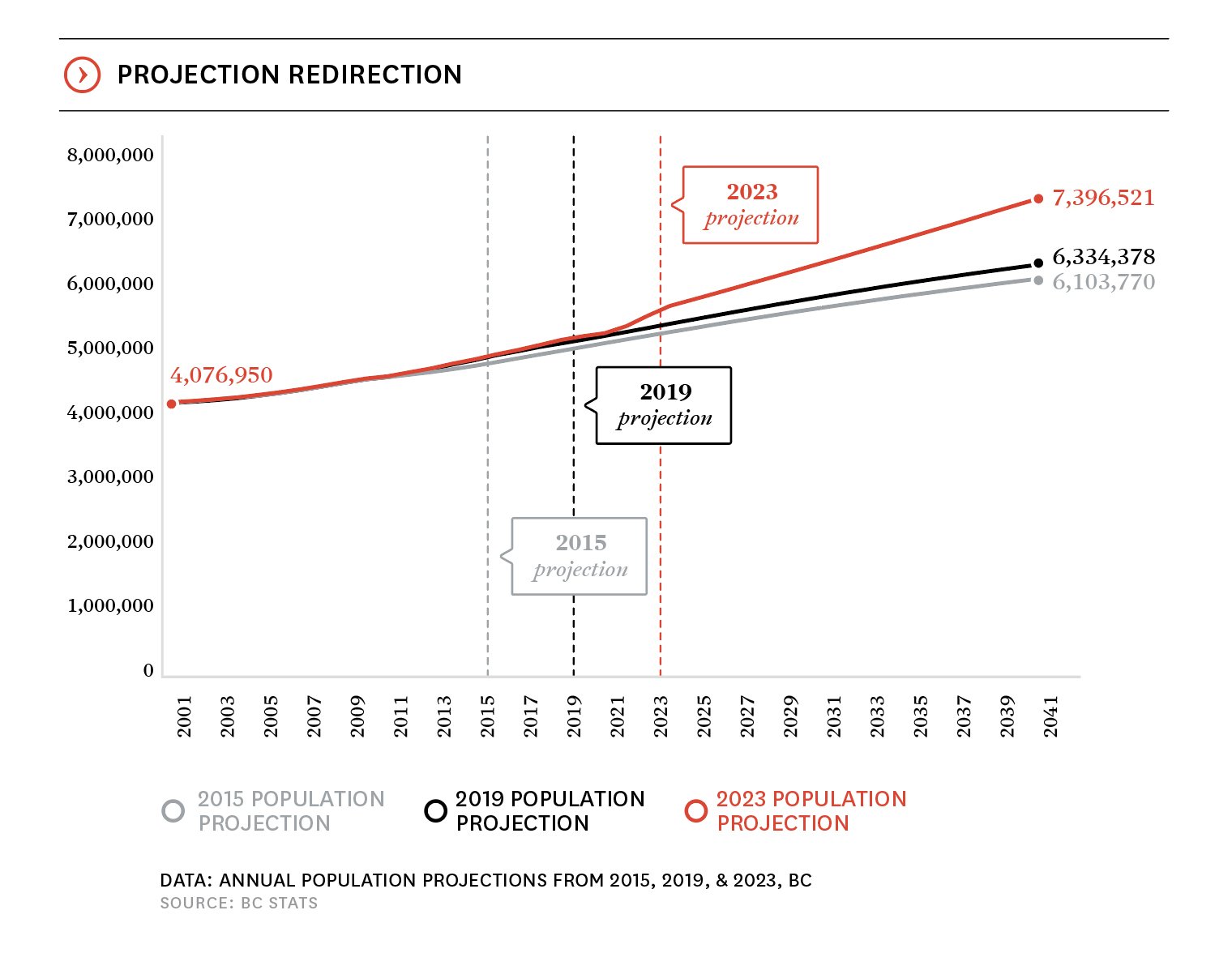
The reason for the drastic changes to these revisions is the recent growth in net international migration, not only from increasing permanent resident additions but also temporary permit holders. The models assume that the growth in temporary migrants is, well, temporary as the rate of growth is expected to slow with growth in the next nine years of 17%, whereas the subsequent nine years is estimated at 15% as temporary migration reverts back to longer term averages.
The new proposed international student cap will have an impact on reducing the amount of population growth we experience in the coming years as well, which we’ll explore in the next section. Building enough housing to accommodate this growth will be a major hurdle, and even though BC started construction on a record number of homes last year (more on that later), it isn’t enough.
Twice a year, rennie intelligence produces the rennie landscape, which tracks a variety of demographic and economic indicators that directly and indirectly influence the housing markets of Metro Vancouver, Greater Victoria, and the Central Okanagan. Our goal is to provide our community with a basis for evaluating the trajectory of the factors that collectively define the context of the real estate market.
Our rennie intelligence team comprises our senior economist, market analysts, and business intelligence analysts. Together, they empower individuals, organizations, and institutions with data-driven market insight and analysis. Experts in real estate dynamics, urban land economics, the macroeconomy, shifting demographics, and data science, their industry-leading data acquisition, analytical systems, and strategic research supports a comprehensive advisory service and forms the basis of frequent reports and public presentations, covering the Vancouver, Kelowna, Victoria, and Seattle marketplaces. Their thoughtful and objective approach embodies the core values of rennie.